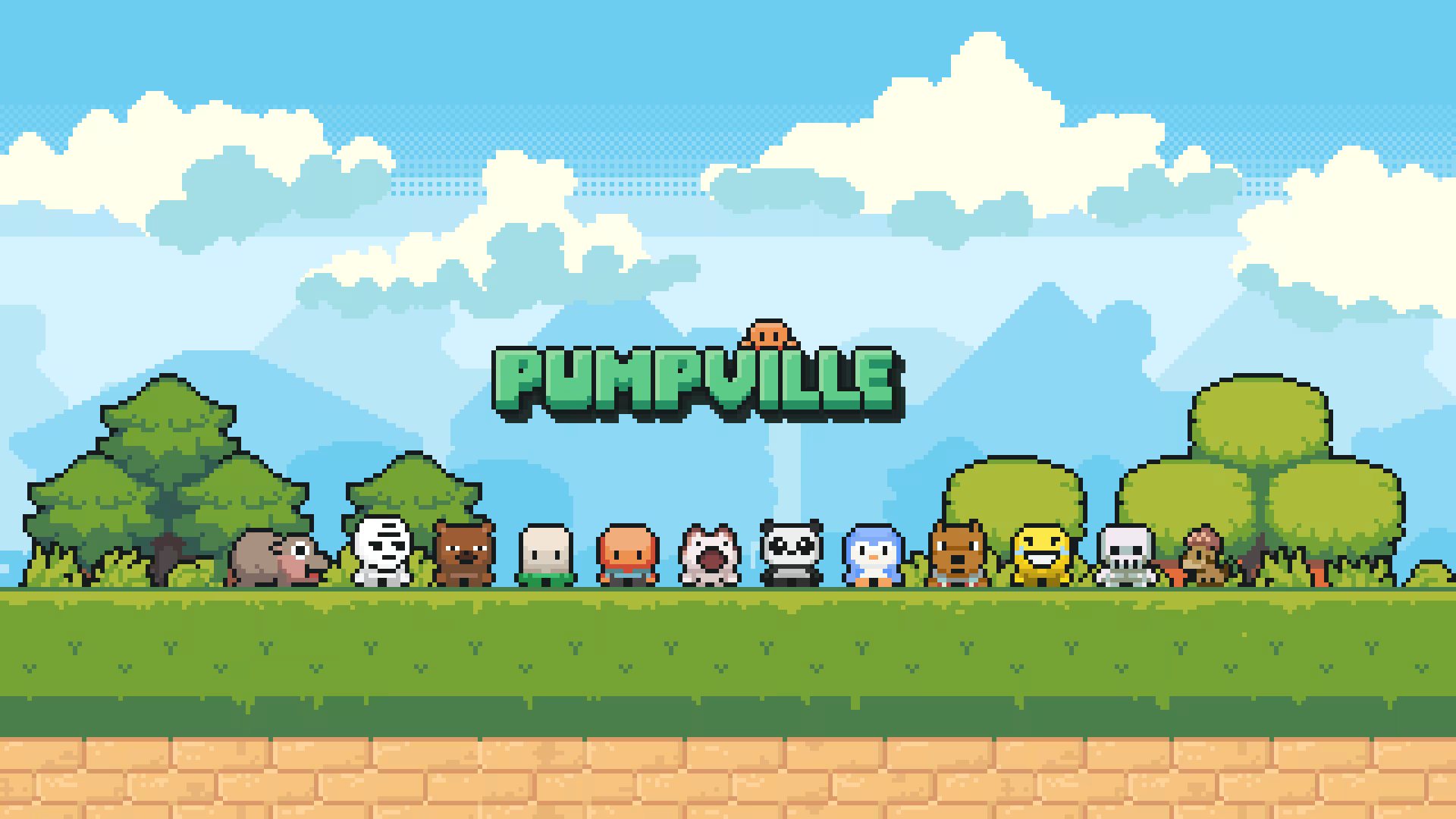
A shared pixel world rather than a single game mode
Pumpville World describes itself as a social multiplayer game on Solana, but its current pitch is broader than a typical arena or quest game. Players are invited into a persistent pixel-art village where they can fish, mine, gather resources, craft equipment, hunt treasure, fight enemies, duel other players and trade items.
The official documentation frames those activities as different reasons to occupy the same world. Some players may focus on progression and gathering, while others use the game as a social space or enter competitive activities. That mix puts Pumpville closer to a small virtual world than a conventional play-to-earn loop built around one repetitive task.
Development shaped around community use
Pumpville is still marked as being in active development. Its documentation distinguishes between currently available systems and longer-term plans, and says future zones may give outside communities dedicated spaces and experiences. This “build in public” approach is the most relevant reason to place the project in the Studios section: the story is as much about production and iteration as it is about the finished game.
Community-led development can produce useful feedback quickly, especially for a social game where empty spaces and weak group activities are immediately visible. It can also create uncertainty. Features, rewards and economic rules may change as the team observes player behavior. Any review should therefore separate what is playable now from roadmap language.
The optional Solana economy
The project says players can access the game for free and earn ordinary in-game Coins through activities. Its Solana token, $PUMPVILLE, is positioned as a premium currency for selected avatars, pets, cosmetics and certain wagered arena modes. The official documentation lists a fixed supply of one billion tokens and publishes a Solana mint address.
Pumpville also states that token spending is divided between permanent burns and a treasury used for rewards, events, marketing and development. That mechanism is a project claim rather than evidence of sustainable demand. Burns can reduce supply, but they do not guarantee a healthy economy, player retention or stable token value.
What the studio needs to demonstrate
Pumpville already communicates a recognizable visual identity and a wide set of activities. The real production challenge is depth. Fishing, crafting, combat and social spaces need enough variation to support repeated sessions, while competitive modes need safeguards appropriate to their use of crypto assets.
The team will also need to communicate regional and age restrictions clearly if wagered matches remain part of the design. Wallet safety, contract transparency and a clean separation between free play and speculative activity should be treated as product requirements rather than legal footnotes.
For now, Pumpville is a credible example of a small web3 studio iterating in public. Its pixel world is playable enough to establish the direction, but the durability of the community and economy will depend on execution over time, not on token mechanics alone.